Tuesday, March 31, 2009

Land of Virtues

Life is wonderful!

I had a joyful opportunity of attending a Buddhist wedding celebration last Sunday at a Buddhist center, Rissho Kosei-kai of Los Angeles.
I believe the atmosphere of any wedding is a good reflection of the quality of lives of a bride and bridegroom. Warm and heartfelt congratulatory messages from friends were a good evidence of wonderful virtues of the new couple, Emi and Mike. A virtue is like a fruit. You cannot obtain it in a short time. But you will eventually get it in the due course of time through every day’s efforts. The Emi ‘tree’ and Mike ‘tree’ are both beautiful trees bearing good fruits, growing on the fertile ground. And I am sure their parents must have diligently prepared the land of boundless virtues for them throughout their lives. I am very proud of Emi and Mike and also their parents. We reap what we sow.

Rev. Taido Matsubara, prominent Zen master residing in Japan, once hiked in a mountain with his college classmates some 80 years ago (he is now 102 years old), he took a short rest by leaning on a big stone, on which he found a short poem inscribed. Since then, the poem had become a guiding principle of his life.
“Look at that!
In such a deep mountain,
A cherry tree is blooming;
Do your best,
even though no one may recognize you.”

Both Emi and Mike are artists.
Below is the link to one of Emi’s work, the world of the Lotus Sutra.
http://www.geocities.jp/koyappy_rkk/gallery/loillust.html

Congratulations, Emi and Mike.

Tuesday, February 10, 2009

Visiting Rissho Kosei-kai of Sumida Dharma Center

I am now in Tokyo. I visited Sumida, one of the old downtown districts in Tokyo today. One of my close friends, Rev. Koichi Saito, who now serves as minister of Rissho Kosei-kai of Sumida, invited me to attend a Hoza session at his Dharma Center. Before visiting the Dharma Center, Mr. Takagi of Rissho Kosei-kai of Sumida kindly guided me to the Memorial Hall in Tokyo.


Mr.Takagi and Memorial Hall


As you may know, Tokyo was destroyed by a gigantic earthquake, called the Great Kanto Earthquake, on September 1, 1923. Buildings and houses were either collapsed or burned down, and 100,000 people were killed. Sumida was one of the most affected areas.
People in Tokyo experienced another serious damage during the World War II. 325 B-29 aircrafts attacked Tokyo on March 10, 1945. A large portion of Tokyo was burned down and nearly 100,000 men and women including children were killed by this US air raid. It is known as Great Tokyo Air Raids.

In the Memorial Hall, all the victims of both the Great Kanto Earthquake and Great Tokyo Air Raids were enshrined. I offered my sincerest prayers to them. I had known about both incidents but by visiting and offering a prayer, my knowledge turned into my own experience. If I had been born at that time in this area, I must have been one of the victims. They lost their lives; I have my life here. I could not help but thinking about the meaning of life of mine and renewed my vow to live my life fully for peace and happiness of all.


Mr. Takagi explained to me that every October, 20-30 religions groups get together to offer prayers for victims. Under the guidance of minister, he had worked hard to make this interfaith prayer service realized. Every year at the prayer service, this Peace Bell is tolled. “May the sound of the bell reach to heart and mind of everyone and peace and harmony prevail in the world”. Mr. Takagi and I prayed together in front of the bell.


In the evening, I attended the Hoza session at Sumida Dharma Center. I was very happy to be with warm and friendly Sumida Sangha. I shared with the youth members the way to happiness. In order to make our lives happier and peaceful, we need to know the path. And we need to walk the path. I shared the path to happiness, known as the Six Perfections.

As you may know, they are;
1. Practice of Giving
2. Practice of Keeping the Precepts.
3. Practice of Perseverance
4. Practice of Efforts.
5. Practice of Meditation
6. Practice of Wisdom

We had good interactions and enjoyed the Hoza.
One man reflected on his everyday life and decided to start giving morning greeting to his parents by warmly saying, “Good Morning”. This is the Practice of Giving.
Another man determined to attend the 6am early morning chanting session for the next 21 days. This is the Practice of Keeping the Precepts.
Another one said that he would be more willingly giving a way to other cars on the street when he drives. This is the Practice of Perseverance.
Another one said that he would work harder at his office. This is the Practice of Efforts.
A young man decided to do Gokuyo, Sutra Recitation, more often. This is the Practice of Mediation.
Another one said that he would attend the hoza more often. This is the Practice of Wisdom.

I saw everyone’s buddha-nature working. And I was convinced that by walking the path we all can become buddhas. We should work together so that all living beings may awaken to the buddha-nature and world peace be achieved.

Saturday, January 31, 2009

Taking a Meal in Awareness

Taking a meal is a very happy occasion.
It gives us great satisfaction particularly when we are very hungry.
Good meal gives energy and strength in keeping our lives.
Eating with family and friends promote good conversation and bonding.
But it gives us much more. Taking a meal is also a precious opportunity of awakening.

Last year, I had a chance to visit the Mt. Hiei, near Kyoto, Japan, for the Tendai “Shi-Kan” meditation retreat. I appreciate generous support of Rev. Kojitsu Kobori, of Enryakuji-Temple. Without his support, this could not have happened.


Daishi-Do Temple on Mt. Hiei, where we stayed for 3 days.
This is the temple for the great master, "Ganzan Daishi Ryogen" (912 - 985 AD)


One of the most inspiring practices was meditation in taking a meal. As you may know, meditation is practiced not only in the sitting mode, but should be practiced in all occasions, including taking a meal.

Before we ate during the retreat on Mt. Hiei, we recited “the Five Contemplations When Taking A Meal”;
1. I consider the work required in producing this food, and I am grateful for its source.
2. I evaluate my virtues and examine any spiritual defects. The ratio between my virtues and
defects determines how much I shall deserve this offering.
3. I guard my heart cautiously from faults, particularly greed.
4. To strengthen and cure my weakening body, I consume this food as medicine.
5. As I continue on the spiritual path, I accept this offering with appreciation and gratitude.

Then, we started eating without any chatting or conversation. We kept eating in silence. It is a very awkward experience but I actually was able to feel and touch the presence of each food I took and also I was able to contemplate the source and life of the food. When I was able to appreciate each food more deeply, I had realized my habitual unconsciousness in food taking. Whenever I eat, I do appreciate food and also people who are involved in producing the food. But I was not truly touching the life of each food deeply. I would eat food basically unconsciously.

When we are hungry, we eat; when we are full, we stop.
When we are thirsty, we drink; when we are no more thirsty, we stop.

Our senses control our actions, when we are unconscious.
Internal and external conditions affect our senses, and our senses lead to actions.
For example, someone cuts in front of the car, and the driver gets angry and starts the road rage…

Full recognition and appreciation of food we take is a practice of awakening from unconscious.
Then instead of our senses controlling ourselves, we are able to control ourselves.

Since my family now lives in Japan, I take a meal alone at apartment in Irvine.
It sounds sad, but this gives me a chance to take a meal in awareness.

What do we do when I eat with family and friends?
Then I enjoy both eating and talking.
I am happy anyway.

Let's continue to practice for awakening!


Silent dinner at the Daishi-Do temple


Gassho
Mizutani

Wednesday, December 31, 2008

Because of you, I am now as I am!


Today is the last day of 2008.
Because this year was the first year at my newly assigned work, I spent more energy than previous years in keeping myself focused. By being focused, we are more empowered. With invaluable support from all beings, 2008 has become one of my most fruitful years with many precious encounters, accomplishments, and awakenings.
One of my awakenings I have experienced this year was that I had realized that because of the works and supports of so many people, I am now as I am.

Translation, publication, and distribution of Buddha Dharma books are some of the major works of mine since this year. These works gave me an opportunity to read a story behind the publication of the English translation of the Lotus Sutra, a major scripture of Mahayana Buddhism. This story was the testimonial speech by Rev. Kojiro Miyasaka, former Director of International Affairs Section of Rissho Kosei-kai Headquarters. His speech tells about how Rissho Kosei-kai Buddhist organization was able to publish the first English translation of the Lotus Sutra from Chinese translation. When I read this story, I was very grateful to Rev. Miyasaka. He became my hero.


After reading his story, I became most grateful to Rev. Bunno Kato, who had translated the Lotus Sutra from Chinese to English in 1925 for the first time in the world. Without his work, I am not able to share beautiful messages of the Lotus Sutra with people in the US.


Then I renewed my appreciation to Rev. Nikkyo Niwano, who taught me the value of Buddha Dharma through his guidance and his life.


Kumarajiva is the great Buddhist translator of 4th Century in China, who translated the Lotus Sutra from Sanskrit to Chinese. I am most grateful to Kumarajiva for his dedication to the work of translation of the Sutra of the Lotus Flower of the Wonderful Dharma.

My deepest appreciation goes to Shakyamuni Buddha, who is the source of wisdom, the source of most fulfilling life.
Then, I was awakened to all those who guided and supported me in pursuing my Buddhist life. They include my parents, my family, Buddhist Sangha in RK Sapporo, all RK Sangha members, and all friends.
Thank you everyone for your support, your life, and your presence.
Because of each and every one of you, I am now as I am!

Gassho
Shoko Mizutani

Sunday, November 30, 2008

Buddhist Heart in Symposium

Thanks to the support of distinguished speakers, UC Irvine faculty members and students, Rissho Kosei-kai Sangha, and all friends, we were successfully able to hold our first symposium on October 18 on UCI campus. I would like to express my gratitude particularly to all volunteers who helped the event. Following wonderful presentations by each speaker, very active interactions between the audience and speakers took place.

I was convinced that deep in heart everyone is sincerely searching the meaning and value of one’s life.

“How can Buddhist practices make a difference in this wounded world?” In reply to this self-questioning, Dr. Ruben Habito emphasized the importance of the Bodhisattva spirit. Then, he referred to the following words of Mr. Kenji Miyazawa, the Japanese poet and author of children’s stories; “There can be no individual happiness until the world as a whole is happy.” These words reflect the Buddha’s vow. From the Buddha’s eyes, everyone actually holds this Buddha’s vow within. The sense of caring others is innate nature of everyone. Unfortunately, however, we often forget this own vow.
I would like to keep cultivating my Buddhist heart so that I always remember this vow within myself and live it sincerely.

Again thank you everyone for your support for the symposium.

Gassho
Mizutani

Saturday, October 11, 2008

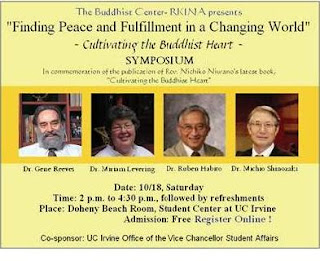
Cultivating the Buddhist Heart Symposium

A symposium I am now working on is just a week ahead.
This symposium offers the opportunity to share and discuss the Buddhist approach to live in peace and fulfillment in our everyday lives, and also to find the way to connect inner peace and external peace in today's world.

I am very grateful to all the support we have received for this event.I hope you can join this symposium. It is free, but the space is limited so please register on line.
The details are below.
Symposium

"Finding Peace and Fulfillment in a Changing World”
- Cultivating the Buddhist Heart –
In commemoration of the publication of Rev. Nichiko Niwano’s latest book,

Date: October 18th, Saturday, 2008
Time: 2 p. m. to 4:30 p. m., followed by refreshments
Place: Doheny Beach Room, Student Center at UC Irvine

Moderator:
Dr. Gene Reeves (Special Minister for the International Buddhist Congregation, Tokyo, Visiting Professor at the University of Peking, Beijing)

Speakers:
1) Dr. Ruben Habito (Professor of World Religions and Spirituality, Southern Methodist University, Dallas, Texas)
“Inner Peace and Global Peace: Cultivating Compassion in a Wounded World”

2) Dr. Miriam Levering (Professor of Religious Studies and Asian Studies, University of Tennessee, Knoxville)
"Impermanence is Everyday: the Thought and Guidance of Nichiko Niwano."

3) Dr. Michio Shinozaki (President, Rissho Kosei-kai Gakurin Seminary, Tokyo)
“Buddhist Visions of Peace in Today’s World: Rev. Nikkyo Niwano’s Vision for Peace

Sponsor: The Buddhist Center - Rissho Kosei-kai International of North America
Co-sponsors:
University of California, Irvine, Office of the Vice Chancellor Student Affairs
Spiritual Alliance at UC Irvine (SAUCI)
Buddhist Association at UC Irvine

Admission: free Everyone is welcome.
Please make reservation by online or contact the RKINA office (949-336-4430).
For the location and parking at the UCI Student Center, please visit; www.studentcenter.uci.edu/information

Mizutani


Saturday, September 27, 2008

Awakening Call

A couple of weeks ago, I was staying at a hotel, in San Antonio, Texas. Around 3 a.m., a room phone rang loudly, and I jumped out of the bed. “Is John, there?” “What?” “Oh, sorry, I have the wrong number.” The conversation ended, but the sensation of blaming this young woman for this careless action started within me. The following morning, I woke up with the sense of blaming her and also blaming myself for not being able to forgive her.

I gradually recalled what was going on the night before; the hurricane was approaching the Gulf area, lots of people were evacuating from that area, the hotel was occupied by many evacuee-like guests, and a group of people entered the room next door at midnight before the phone rang…… Most probably, the young woman was a family member from the Gulf region. I was ashamed of myself for having decided that she lacked common sense. When I saw it all clearly, my mind was freed. And I realized myself now worrying about and praying for the victims of the hurricane.

We react based on our own interpretation. By clearing our views and building our capacity to recognize everything as it is, we are able to see the beautiful nature of every being, and consequently peace, compassion, and dedication are revealed within ourselves. This is the meaning of awakening to the truth of the universe. Everyone has buddha-nature, most beautiful nature and also potential of awakening. Awakening to the truth of universe is assured to everyone in the Lotus Sutra.

The midnight phone brought me awakening.
Gassho
Shoko Mizutani