The theme was "The Practice of Compassion."
I would like to share with you my presentation.

I. Introduction
Good Morning, friends!
Thank you very much for having me here at this beautiful Pacific Unitarian church in this beautiful Sunday morning.
I am deeply grateful to all Unitarian Universalists fellow members, as you have actually made a significant impact on my life.
How?
Rissho Kosei-kai is a Buddhist organization founded by Rev. Nikkyo Niwano in 1938 in Tokyo. My parents joined Rissho Kosei-kai when I was small and I respected them very much because of their dedication in practicing Buddhism in their life. But I had a negative view on religion in general as it often becomes a cause of wars instead of cause of peace. I was deeply touched when I learned about Rissho Kosei-kai’s active work for global peace through interfaith cooperation. I wished to walk the Way of the Buddha as my parents, in the Buddhist organization which was founded and guided by such an inspired leader, Rev. Niwano. So I decided to join Kosei-kai 30 some years ago.
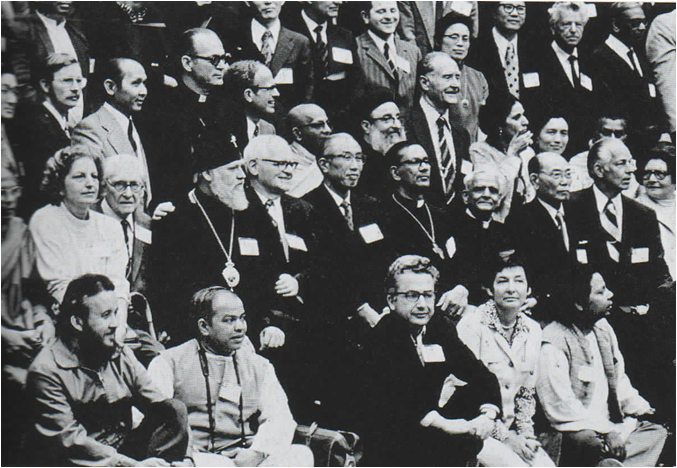
After a few years, I came to know a story of historical encounter of Rev. Niwano with Unitarian Universalists, and particularly Dr. Dana Greely, then president of UUA. Rev. Niwano was surprised to have found the strong similarities between Unitarians and Rissho Kosei-kai in formation, ideas, and purpose. And Rev. Niwano sensed a strong feeling of brotherhood and even unity with Dr. Greely. Rev. Niwano got tremendous inspiration and spiritual support from Unitarians and Dr. Greely for his pursuits of interfaith work.
Without Rissho Kosei-kai’s active engagement in interfaith cooperation and global peace, I may not have started my Buddhist life. For this reason, I owe great indebtedness of gratitude to you all.

II. What is Compassion?
In the United States, more people are interested in Buddhism. And I have come to know some Buddhist jokes. I would like to share one story with you.
One woman asked, “Why couldn’t the Buddha vacuum under a sofa?”
Husband answered, “Because he had no attachments.”
Buddha was born in India as a prince of a kingdom 2500 years ago. In his sincere search of truth, he renounced all his wealth and family, and he became an ascetic. After 6 years of arduous practices, he sat under a bodhi tree, where he awakened to the truth of the universe. Being free from attachment and illusions, he attained perfect peace and happiness. He became an enlightened one, the Buddha.
What is wisdom?
Wisdom of the Buddha is not mere intelligence or cleverness but an all-encompassing wisdom that grasps the essence of all things. It is the wisdom that sees the reality of all beings. All beings are constantly changing through interaction with each other. All beings are sharing one great life. Therefore, all beings are fundamentally equal and all precious. From the eyes of the Buddha at the time of his enlightenment, it is said that he was able to see wisdom and virtuous signs embraced within all human beings. All beings looked shining in radiance.
Because of illusion and attachment, however, people obscure the mind and cannot see the reality as it is. People see only the surface of things, instead of seeing deeply. They see things and judge in a short scope instead of longer scope. People see things dualistically, judging things good or bad, right or wrong, like or dislike, and I and others. Because of these shallow observations and false judgments, they enter into illusionary thought, creating suffering by themselves.
It was Buddha’s earnest wish to free them from suffering. This is why Buddha started sharing the Dharma, Buddhist teachings, so that they can remove illusion, liberate themselves from sufferings, and eventually attain supreme wisdom and compassion, the same as the Buddha himself. He opened the way to become a buddha. And he showed the way to become a buddha, so that everyone can unfold one’s innate wisdom and compassion, by following the way.
Dharma is the core of one’s peaceful and fulfilling life.
Universal truth manifests in many forms. It is our understanding that all faith traditions are the manifestations of this truth. And all teachings are important paths to come to grasp this truth. Buddhism is one of important paths for awakening, which I follow.
What is compassion?
Compassion is deep sympathy. It is the wish to relieve others of their sufferings and the wish to make others happy. Everyone has this mind within. It is the purpose of Buddhism to nurture genuine compassion.
Compassion arises from understanding the true nature of reality. Buddha perceived equality of human beings’ true nature, called Buddha nature. By realizing this equality, we are able to experience the knowledge that we and others are one, thus allowing deep compassion to be generated from within.
When I cut my finger, I spontaneously hold with it with my other hand. When my wife cuts her finger, I sense pain but it is not the same as my own. When someone else cuts their finger, the sense is much less. Why?
From the Buddha’s eyes, we are one. But from the ordinary eyes, we are all separated. Clearer understanding of the reality helps us generate compassion.
The other day, I saw a lady walking on a parking lot in front of our office in Irvine. A car approached behind her and honked. She was very surprised and turned her back to see the driver. I saw on her face a sense of surprise and little anger. Interestingly her angry face turned to smiling face when she realized that the driver was her friend, who was waving his hand with a big smile.
If we see this world as it is, we can live in friendship and compassion, instead of hatred and conflict.
Compassion and attachment are different. Attachment arises in the mind of self-centeredness. Compassion arises when we overcome ego mind. Wisdom to see the interconnectedness of all beings generates compassion.
One Buddhist sutra says, “This sutra can make one without kindness give rise to the mind of compassion.”
Sharing the Dharma was the Buddha’s utmost compassion.
 III. The Practice of Compassion
Compassion is not just for Buddhists. It is the Universal Truth. Everyone who diligently lives the truth similarly embraces warmness, compassion, and wisdom.
I had a chance to meet Mother Teresa about 20 years ago. I visited her center, called Missionaries of Charity in Calcutta in order to offer our Donate-a-Meal Peace fund to her work. This Peace fund comes from RK members’ Donate-a-Meal practice. In this practice, we skip a meal once a week, and share the hunger and pain with those who are in difficult situations. With a prayer in compassion, we donate the money equivalent to the meal we skip.
In order to prepare myself for meeting with Mother, I spent three days in one of her homes for the poor, where I washed the body of old men and cleaned the floor. Mother was always with God, and what I thought I needed to do was to strengthen my connection with the Buddha. Then God and Buddha would take care of the rest.
When I visited her office, she welcomed me in such a beautiful smile. She was very small but radiant, shining, soft, and smiling. She proposed to use our donation for constructing a correction center for girls.
At my second visit, Mother took us to the building site. We got on a small taxi, where I was sitting next to Mother, touching her shoulder. Living and working in a slum in Calcutta must be harsh. I asked her if she was physically all right. “There are many things to get done. I cannot take a rest.” She answered in big smile. She was truly a manifestation of compassion.

Her smile resonated Founder Niwano. It was one or two years before he passed away. As he was aging, he stayed in bed most of the day. One of senior members who was attending just by the side of his bed, said, “Founder, I am sorry, but lately you cannot do as much work as you used to do.” Founder smilingly said, “Oh, not at all. While closing my eyes, I am offering my sincere prayers to all RK members and everyone in the world. That keeps me quite busy.” He pursued the practice of revering every one’s Buddha-nature.
The practice of compassion is the result of one’s enlightened nature. Those who have come to know the all-encompassing wisdom can continue to find creative and appropriate ways to render warm and generous support and inspiration to others, even though they may be in a most difficult situation. Genuine compassion is the sign of one’s high spirituality and accomplishing profound religious practices.
On the other hand, practice of compassion is the starting point of one’s spiritual journey as well. The six perfections, known as the practice of bodhisattvas, start with the practice of compassion. Rev. Nichiko Niwano, current President of RK guides us as, “When we free ourselves from attachments by giving, we are able to see things the way they really are. Through this, our fixed ideas are removed, the wisdom-eyes that are inherent to human nature are opened, and then we begin to see the ultimate reality of all things. Indeed, we can say that giving leads to wisdom.”
 What are the practices of compassion in Rissho Kosei-kai, besides Donate-a-Meal practice?
1) At family level, family members greet each other in the morning. You and I are the one to greet first. If you are already practicing, then greet with more compassion and smile. This will bring wonderful energy into our home. Don’t get discouraged even though someone you greeted did not respond well. We practice to cultivate our own heart and mind, not as much as that of others. Kind words with friendly smile are not limited to home but it is universally important. Founder Niwano always had a big smile. This smile has become RK’s treasure.
2) Practice of compassion at your work place and community is important. We practice so that our surroundings become more harmonious. One member in Denver had some difficulty in relationship with her boss. She reflected and came to decide to practice compassion at her office. She started to come in earlier and made coffee for the entire floor. And she started to serve the first cup of coffee to her boss every day. Her boss was very surprised but she continued with sincerity so that she can cleanse her mind. And she recognized much change within her and also in her relationship with boss also. She has been continuing this practice for 2 years. I learned the importance of practice from her, she is a highly intellectual American lady with a law school degree.

3) Practice of compassion is also practiced in our Sangha as pastoral care. In RK, we care about each other and walk the path together.
It was soon after I joined RK, when I had a very important experience. There was one mother in my Buddhist Sangha. One day she asked me if I could help her 14 year-old son get out from his messy and rough life. Let me call him Tad. He often cuts school and would hang out in town with friends.
I visited Tad at his home. He was 10 years younger than me, and apparently he was not a person whom I dared to associate with. At first, he was not at all friendly to me, but I started visiting him once in a while. I continued to visit him not only because I had learned the importance of compassion as a Buddhist practice, but also because I wanted to help him out. I offered him tutoring. I taught him math. “How can I be much closer to him?” I tried to do everything that had come up to my mind, like cooking dinner for him. I even shared a story of the stupidest thing I had done when I was younger. Awkward conversations between he and I gradually became smoother and more friendly ones. While I continued to be his teacher; he became my teacher in video games.
I was shocked when his mother informed me that he had disappeared. He had left home. I felt powerless and the only thing I was able to think of, was sitting in front of a small Buddhist altar in my room to offer the sincerest recitation of the Lotus Sutra to the Buddha and all divine deities, wishing that he was all right. Caring about him was actually my first experience of caring for others, and this prayer was the most sincere prayer I had ever offered in my life.
While I was praying, time passed and the room was getting dark. At that time, something unusual took place within me. I intuitively realized the love and care of my parents that must be far greater than my prayer and care for this young man. I also realized that I was, and had always been in the midst of loving care, compassion, and prayers from innumerable people. There in the dark, I cried with gratitude.
I was very delighted to hear that Tad had eventually come back home. I started tutoring him again. After several months, I left the town to enter the RK’s seminary in Tokyo. Two years later, I was informed that he had passed away at the age of 17, due to an overdose of sniffing paint thinner. I was very sorry that I was not able to help him out of his difficulty. On the contrary, he had helped me walk the path of the Buddha. He taught me compassion is not only for others, but also for the one who practices. He continues to live within me, and his compassion is still guiding me.

IV. Conclusion
In a larger scope, we are living in the midst of compassion. Whether I am compassionate or not, I find myself in the blessings of my family, friends, nature, and all beings. It is true that there are difficulties and hardship.
Within a scope that getting what we wish is good and getting things against our wish is bad, then we cannot say all are blessings. But the Universal Truth is always working for my awakening, your awakening, and everyone’s. Through failures, we build our wisdom. Through misfortune, we nurture the depth of our human nature. Through all these experiences, we grow our human values. By recognizing that every experience is the opportunity of our growth, we understand we are always in compassion.
Thanks to your invitation to this Sunday service, I was able to take time to study the Buddha’s teaching and reflect on myself.
And I found myself in the midst of compassion right now.
Let us continue to walk together on our spiritual paths, and generate more genuine compassion within and around us, so that we can create a more peaceful and compassionate world.
I would like to finish with this thought:
“The sun never said to the earth, ‘You owe me’. See what can happen with a love like that – it can light the world.”
May all beings be in peace and happiness.
Thank you very much.




 The panelists are Professor Jack Miles of UCI, Pulitzer Prize winner, Pastor Eric Smith of University United Methodist Church, Dr. Willian Vendley, Secretary General of


 [Causes of Global challenges]


 Buddhism is a Way to benefit all beings in the world and to promote ones’ own human values. By engaging ourselves in benefiting others, we are further awakened to a deeper compassion and wisdom. And through promoting human values of all beings, can peace in the world be secured.


