Sunday, November 30, 2008

Buddhist Heart in Symposium

Thanks to the support of distinguished speakers, UC Irvine faculty members and students, Rissho Kosei-kai Sangha, and all friends, we were successfully able to hold our first symposium on October 18 on UCI campus. I would like to express my gratitude particularly to all volunteers who helped the event. Following wonderful presentations by each speaker, very active interactions between the audience and speakers took place.

I was convinced that deep in heart everyone is sincerely searching the meaning and value of one’s life.

“How can Buddhist practices make a difference in this wounded world?” In reply to this self-questioning, Dr. Ruben Habito emphasized the importance of the Bodhisattva spirit. Then, he referred to the following words of Mr. Kenji Miyazawa, the Japanese poet and author of children’s stories; “There can be no individual happiness until the world as a whole is happy.” These words reflect the Buddha’s vow. From the Buddha’s eyes, everyone actually holds this Buddha’s vow within. The sense of caring others is innate nature of everyone. Unfortunately, however, we often forget this own vow.
I would like to keep cultivating my Buddhist heart so that I always remember this vow within myself and live it sincerely.

Again thank you everyone for your support for the symposium.

Gassho
Mizutani

Saturday, October 11, 2008

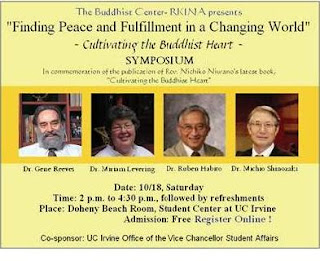
Cultivating the Buddhist Heart Symposium

A symposium I am now working on is just a week ahead.
This symposium offers the opportunity to share and discuss the Buddhist approach to live in peace and fulfillment in our everyday lives, and also to find the way to connect inner peace and external peace in today's world.

I am very grateful to all the support we have received for this event.I hope you can join this symposium. It is free, but the space is limited so please register on line.
The details are below.
Symposium

"Finding Peace and Fulfillment in a Changing World”
- Cultivating the Buddhist Heart –
In commemoration of the publication of Rev. Nichiko Niwano’s latest book,

Date: October 18th, Saturday, 2008
Time: 2 p. m. to 4:30 p. m., followed by refreshments
Place: Doheny Beach Room, Student Center at UC Irvine

Moderator:
Dr. Gene Reeves (Special Minister for the International Buddhist Congregation, Tokyo, Visiting Professor at the University of Peking, Beijing)

Speakers:
1) Dr. Ruben Habito (Professor of World Religions and Spirituality, Southern Methodist University, Dallas, Texas)
“Inner Peace and Global Peace: Cultivating Compassion in a Wounded World”

2) Dr. Miriam Levering (Professor of Religious Studies and Asian Studies, University of Tennessee, Knoxville)
"Impermanence is Everyday: the Thought and Guidance of Nichiko Niwano."

3) Dr. Michio Shinozaki (President, Rissho Kosei-kai Gakurin Seminary, Tokyo)
“Buddhist Visions of Peace in Today’s World: Rev. Nikkyo Niwano’s Vision for Peace

Sponsor: The Buddhist Center - Rissho Kosei-kai International of North America
Co-sponsors:
University of California, Irvine, Office of the Vice Chancellor Student Affairs
Spiritual Alliance at UC Irvine (SAUCI)
Buddhist Association at UC Irvine

Admission: free Everyone is welcome.
Please make reservation by online or contact the RKINA office (949-336-4430).
For the location and parking at the UCI Student Center, please visit; www.studentcenter.uci.edu/information

Mizutani


Saturday, September 27, 2008

Awakening Call

A couple of weeks ago, I was staying at a hotel, in San Antonio, Texas. Around 3 a.m., a room phone rang loudly, and I jumped out of the bed. “Is John, there?” “What?” “Oh, sorry, I have the wrong number.” The conversation ended, but the sensation of blaming this young woman for this careless action started within me. The following morning, I woke up with the sense of blaming her and also blaming myself for not being able to forgive her.

I gradually recalled what was going on the night before; the hurricane was approaching the Gulf area, lots of people were evacuating from that area, the hotel was occupied by many evacuee-like guests, and a group of people entered the room next door at midnight before the phone rang…… Most probably, the young woman was a family member from the Gulf region. I was ashamed of myself for having decided that she lacked common sense. When I saw it all clearly, my mind was freed. And I realized myself now worrying about and praying for the victims of the hurricane.

We react based on our own interpretation. By clearing our views and building our capacity to recognize everything as it is, we are able to see the beautiful nature of every being, and consequently peace, compassion, and dedication are revealed within ourselves. This is the meaning of awakening to the truth of the universe. Everyone has buddha-nature, most beautiful nature and also potential of awakening. Awakening to the truth of universe is assured to everyone in the Lotus Sutra.

The midnight phone brought me awakening.
Gassho
Shoko Mizutani

Sunday, August 31, 2008

Live the Dharma

We had the first Dharma Study session last Tuesday, August 26th, here at the Buddhist Center - RKINA.
We started with short meditation. It is very calming to sit quietly, particularly after a hard working day.

The study was on the Life of the Buddha.
The Buddha was enlightened to the Dharma, shared the Dharma, and lived the Dharma. So the theme of this session is ‘Live the Dharma’.
I shared one story from a book, "Shakyamuni Buddha" by Nikkyo Niwano.

"The Buddha was meditating under a tree in a forest when a large group of young men rushed to him, saying, 'Sage, have you just now seen a young woman pass by here?'

“Calmly opening his half-closed eyes, the Buddha said, 'No, I have not seen such a woman. Why do you seek her?'

“Then the young men told him that the woman had stolen their valuables and disappeared.

“After hearing the story, the Buddha asked them gently.‘Which do you think more important, to seek that woman or to seek yourselves?’

“Startled by the Buddha's words, the young men realized they were being asked a very serious question and assumed a respectful attitude. ‘Oh Sage, we think it is more important to seek ourselves.’

“The Buddha then taught them the Dharma in plain words. The young men all attained the initial stage of enlightenment and became his disciples.”

This is a very significant story.
There is an assumption that if we find “the woman”, we will get back the treasure, and then our anger will go away and we will become happy. But the Buddha is posing a question whether our peace and happiness depends on “the woman”, or “ourselves”.

In the Law of the Twelve Causes, it is revealed that ignorance is the fundamental cause of suffering. So the true way for liberation from suffering and for attainment of complete peace is the process of getting rid of ignorance, or awakening to the truth. Searching the woman without trying to eliminate the fundamental cause of suffering is futile. The process of awakening is the way for the complete peace, and this is the meaning of “seeking yourselves.”

I often seek “the woman” in different form, instead of seeking myself. All forms of irritation tempt me to fix up superficial external causes that create my irritation; a too slow car in front of me, an impolite sales guy in a shop, resentful attitude of my daughter... All these encounters are actually important opportunities for reflection and application of the Dharma. This is the practice of seeking ourselves, the way for awakening.

Come and see our ‘Live the Dharma’ Study session. And let’s live the Dharma.
Mizutani

Sunday, August 10, 2008

The accumulation of realization


After the evening sutra recitation, I felt very appreciative that I have made this Buddhist practice as one of my daily spiritual routine. When I am sitting in front of the Buddha statue at home and doing recitation and meditation, I am very peaceful in most of the time. Having peace in heart and mind is very grateful, as we cannot be peaceful when something uneasy happens. It is true that worries will bring worring things, whereas joy will bring joyful things. The occurrence of something wonderful or accomplishment of something great is always grateful. But the beauty and even miracle can be found in the day of no special occurrences and no special accomplishments. Sutra recitation is the practice of appreciating the moment. Peace is here.

When I was writing my own Dharma Journey for the RKINA website yesterday, I recalled the time when I first walked into one Rissho Kosei-kai Buddhist Center in Japan just 30 years ago. So I have been sitting and reciting the words of the Buddha written in the Lotus Sutra for 30 years.

I wrote in my Dharma Journey in the RKINA web, as
“I need to confess that I am not yet fully enlightened and I still suffer from illusion and attachment. If I had not had the knowledge and practice of the Dharma, however, I would not have had my present peace and joy. I deeply appreciate the Buddha, Dharma, and Sangha. I think that the Buddhist Way is not all or nothing or enlightened or not-enlightened. But with the Dharma, we are able to have many awakening experiences; they may be often small ones. Founder Nikkyo Niwano says, “The accumulation of ‘I see!’ moments of realization, lead to enlightenment,” in the Thought of the Week. I appreciate all the realization I have had in my Buddhist Way.”

Gassho
Mizutani

Sunday, August 3, 2008

Source of Happiness -2-


Since I had read “The Thought of the Week” on our Buddhist Center homepage for this week, which is “The source of happiness is the ability to feel gratitude”, it has really become “My Though of the Week”. I have been more reflective this week and tried to look for “the source of happiness” around myself.

Then I found a message attached at the end of an email from one Professor at the University of California, Irvine. The message is “Three Sources of Lasting Happiness” at the end of his email.  The sender is Dr. Roger Walsh, Professor of psychiatry, philosophy, and anthropology at the UCI, who is the author of Essential Spirituality. I happened to meet him on campus at one occasion.

His message is:

WHAT MAKES FOR LASTING HAPPINESS?
Everyone wants to be happy but what makes for lasting happiness? Interestingly, research is now validating ancient wisdom in many ways. Money, for example, is surprisingly ineffective-- it can alleviate the suffering of deprivation, but above a certain minimum does precious little to increase lasting happiness.
So what does work? Many things will bump up happiness temporarily, but long term is a very different matter. Researchers have found three things that succeed in doing this. What are they?
1) Cultivating gratitude, and particularly effective is writing down something each day for which you feel grateful.
2) Reframing difficult experiences in a positive way. This, of course, is the old practice of looking for the silver lining.
3) Generosity. The old wisdom is true--in giving to others we give to ourselves, and the happy result is what's called a "helper's high."
May you be happy!

These three things have universal values. They are applicable to anyone. I found myself very fortunate, as I have learned these points in Buddhist tradition and been incorporating them in my everyday life. How grateful it is!

I would like to add one YOUTUBE film here, which inspires us to be more aware of the blessings we have now.
Enjoy!


The Story of A Sign


In deep respect,

Shoko Mizutani

Monday, July 28, 2008

The Source of Happiness

We are happy when things go well, and we are unhappy when things don’t go well. For me, for example, I am happy when I eat good sushi. I feel irritated when someone behind my vehicle honks. I have recognized that we are actually very much dependent on what happens with us for our happiness.
Buddhism teaches us that our happiness should not depend on someone but should depend on ourselves. And in order to make ourselves dependable, we need to know the Dharma.
Through the study and practice of Buddhism, we are able to build wider scope and clearer mind to see the reality of all beings. From the enlightened eyes, it is seen that we are caused to live in the midst of uncountable blessings at this right moment. The clearer our mind is, the higher sense of gratitude and happiness we would have.

This is the story from “Invisible Eyelash” by Rev. Nikkyo Niwano.
‘Near the gate of the temple Nanzen-ji in Kyoto, there once lived an old woman whom everyone called Tearful Granny. Rainy or shine, she was always in tears. One day the chief priest asked her, “What could be so sad that it makes you cry all the time?” The old woman replied, “I have two sons, one an umbrella-maker at Sanjo and the other a sandal-maker at Gojo. When it rains, I know people won’t want to go out and buy sandals from my first son, and that makes me sad. When the sun comes out, I realize people won’t buy umbrella from my second son, and I grieve over that.’ The priest said, “How about looking at it the other way around? When it rains, be glad that people will buy lots of umbrellas. When the weather improves, rejoice that your other son’s sandal business will prosper.” The old woman took his point. “You’re right,” she said, and from that day on she always smiled and lived happily.’
Rev. Niwano continues, ‘Most people, when they hear this story, laugh at the old woman’s foolishness. However, it is not something that can be so easily laughed away, because many people, big or small, think like this. By searching for the seeds of discontent in one’s surrounding, one makes oneself unhappy.’

“The Thought of the Week” on our RKINA homepage for this week is “The source of happiness is the ability to feel gratitude”. Knowing the Dharma is the key to build the ability to feel gratitude. Let’s study the Dharma with us.

Shoko Mizutani